


One Crucial Watercolor Supply No One Talks About
When people talk about watercolor supplies, everyone talks about the paper, the paints, the brushes. I get why – those are the showy supplies that make watercolor fun. But there’s one supply almost no one talks about that’s just as important: a stretching board, also called a board for stretching your paper.
Two Ways to Stretch Your Watercolor Paper
Unless you’re working with extremely heavy (and pricey) watercolor paper, you’ll need to stretch your paper to prevent buckling and warping from water. There are two ways to do this: buy paper that’s already pre-stretched for you – known as a watercolor block – or stretch the paper yourself onto a wooden board, which is what I’m covering here.

Why Have a Paper Stretching Board?
There are three reasons a paper stretching board is so helpful to a watercolorist.
Reason #1: It Prevents Warping
A board keeps your paper from warping while you paint on it. That means a flatter surface to work on, and less paint pooling in the dips that warping creates on your page.
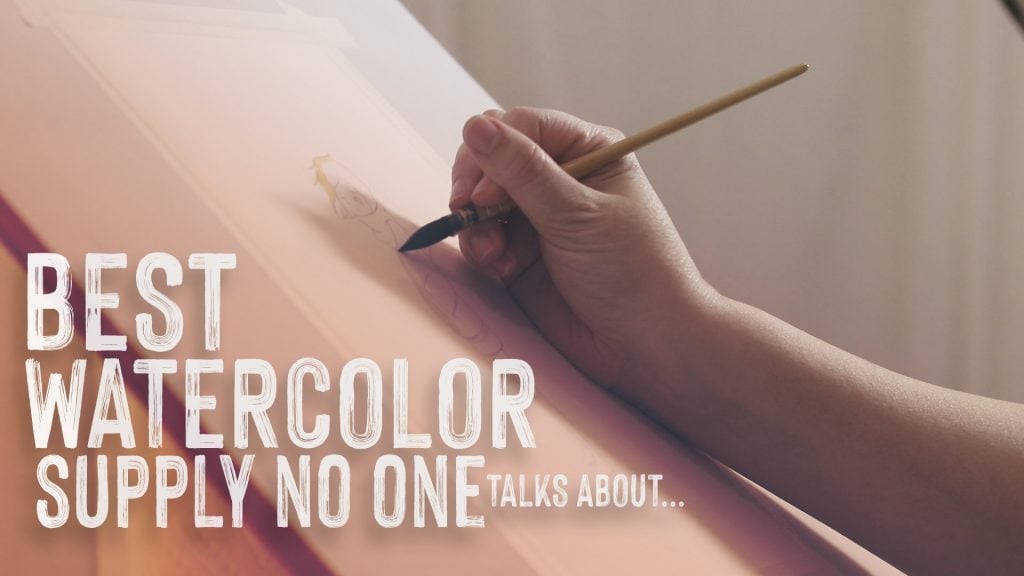
Reason #2: It’s Easy to Tilt and Move
A board makes your workflow easier because you can move or tilt your paper as you paint. Especially on larger, more wet-on-dry sections, tilting the board lets gravity help pull the paint into a smooth wash instead of you fighting to push it in one direction by hand.
Reason #3: Your Paper Can Take More Abuse
Stretched to a flat board, your paper can take a lot more water abuse. Think of your paper like the top of a drum – taut and smooth. As you add water, the paper expands slightly and ripples. As it dries, it shrinks back to taut and smooth again. Because the board resists that movement, you can push more water onto the page without warping it out of shape as quickly. You’ll still get some warping while you paint – just much less than if you were working unstretched or on a thin sheet of cardboard.
What Kind of Wood Board to Use
I use a birch plywood board, cut down into a square. I asked the lumber department at the hardware store what would hold up to repeated water abuse, and birch was their recommendation – the same wood used in log cabins to keep water out. I’ve used a birch board ever since and it’s held up well. I paint the top with white chalk paint, partly so my white balance is easier to nail on camera, and partly because the paint adds an extra sealed layer of protection against the water.
How to Stretch Watercolor Paper Onto a Board
The traditional stretching method is what makes even cheaper, student-grade paper hold up to a lot more wet-on-wet work. Here’s the basic process:
- Wet both sides of your paper until it’s fully pliable.
- Lay it onto your board and staple all the way around the edges.
- Let it dry completely before you start painting.
As the wet paper dries, it shrinks back toward its original size, and the staples holding the edges in place pull it drum-tight against the board. That tension is what lets you paint with more water without the paper buckling or warping.
So There You Have It
Those are the reasons a stretching board earns a permanent spot in my watercolor supplies, even though it never makes it into the “showy supplies” conversation. Happy painting, y’all!