

Not gonna lie – when you’re standing in a store trying to buy watercolor paper, the options can be overwhelming (not to mention the prices). But does painting on a heavier paper weight actually make a difference?
Short answer: yes, weight matters a lot. The number printed on your paper – like 140 lb or 300 gsm – isn’t telling you anything about quality. It’s telling you the weight of a single sheet from a specified ream, which is really a stand-in for how thick that paper is. The lighter the weight, the more buckling and warping you’ll get, especially once water hits the page. The higher the weight, the thicker the paper, and the less warping you’ll deal with.
The 4 Common Watercolor Paper Weights (lb and GSM)
There are four weights you’ll run into most often, and I tested all of them side by side for this study:
- 90 lb (about 190 gsm)
- 140 lb (about 300 gsm)
- 300 lb (about 640 gsm)
- 400 lb (about 850 gsm)
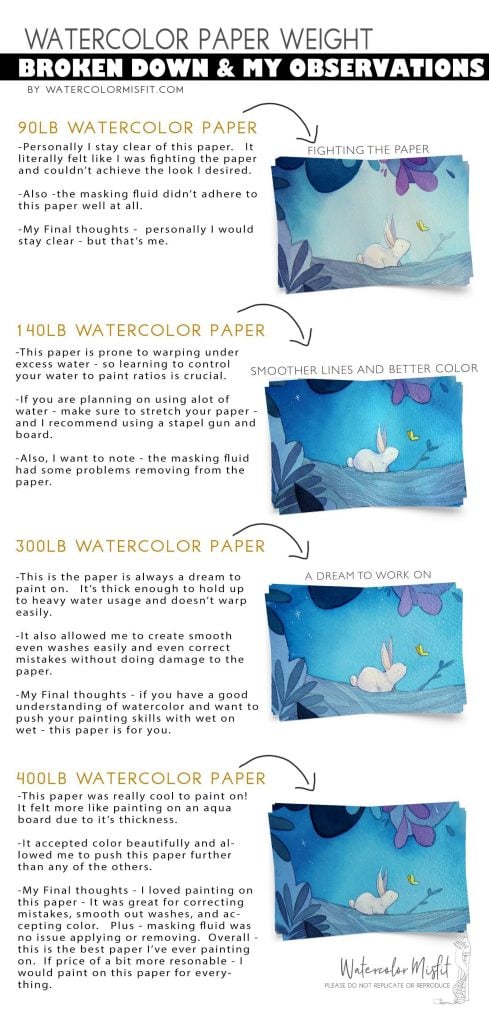
To really push each paper, I painted the same illustration four times – once on each weight – and I purposely used a ton of water and masking fluid on all four, since those are the two things I’ve found most likely to warp or damage a sheet.
My Thoughts From The Study
90 lb (about 190 gsm)
I personally stay clear of anything less than 140 lb, and after this study I’ll especially be staying clear of 90 lb. I know some artists work on it just fine, but for me it always feels like I’m fighting the paper, and the finished painting never quite matches what I saw in my head. The masking fluid didn’t adhere well either – it created weird lines around the edges, pulled paint out from underneath it, and slightly damaged and ripped the paper when I removed it. My take: 90 lb is okay for quick studies that don’t involve much water, but it’s easy to overwork, hard to correct mistakes on, and it doesn’t hold up to wet-into-wet at all.
140 lb (about 300 gsm)
This is the paper I grew up painting on and have used for years. It’s prone to warping when you use a lot of water, so learning water control – and planning ahead – really matters here. It’s also easy to overwork if you’re lifting paint or adding more paint while the page is still wet. The masking fluid didn’t adhere quite as nicely as I wanted, so I had to clean up the edges with a bit of white ink, which is a normal fix. My take: 140 lb is a great beginner paper and, in my opinion, the best weight for learning watercolor. I still reach for it constantly when I’m experimenting with new techniques – just don’t expect it to hold up under heavily saturated wet-into-wet backgrounds or pouring techniques.
300 lb (about 640 gsm)
This paper is a dream to paint on. It’s thick, it holds up beautifully to heavy water usage, and it doesn’t warp easily. It absorbs color nicely, which helps me build smooth washes, and it’s forgiving enough that I can correct mistakes without damaging the sheet. Because it’s thicker, you can also stack on a lot more layers and glazes for rich, deep illustrations. Masking fluid on this paper is also a dream – smooth edges, easy adhesion, and it lifted off cleanly. This is one of my favorite weights to actually paint on.
400 lb (about 850 gsm)
And finally, the paper everyone’s curious about. Through the whole painting process, I never felt like I was fighting this paper – it felt like it was working with me. It accepted color like a sponge, let me push much further into wet-into-wet techniques, and let me correct a couple of mistakes without any real issues. The one downside: the wait time between layers was noticeably longer than on the other three papers, so budget extra drying time if you paint on it.
So Which Paper Weight Is Most Worth It?
Does painting on 400lb watercolor paper actually make a difference?
Well, first off – heck yeah it does! Painting on 400 lb paper was so cool, and it was a noticeably bigger jump than even the difference between 300 lb and 140 lb. If you ever get the chance to paint on it at least once, do it. That said, my two most-worth-it papers for my personal painting style are still the 140 lb and 300 lb weights – especially since I can get both pre-stretched in blocks, which eliminates the warping issue entirely.
If you want to paint with a ton of water and really push your watercolors – especially pouring or heavy wet-into-wet techniques – 400 lb paper is the way to go. To save money, I’d recommend buying it as a full sheet and cutting it into smaller portions. My sheet cost around $22 at the time, and I got four paintings out of it. I’m planning to keep exploring with the rest of that sheet, so follow me on Instagram if you’d like to see those explorations.
Anyway, that’s it for this post – hopefully you got to see the differences between the four common weights of watercolor paper and can make a decision for yourself about what to paint on next.