

Have you ever looked closely – and I mean really close – at the surface of your watercolor paper? Some papers have this bumpy texture, whereas others don’t. Is there a purpose? And which one should you actually be using?
What you’re looking at is the texture of the paper, often called its “tooth.” That tooth is the difference between two types of watercolor paper – hot press and cold press. (There’s a third, rougher-toothed paper called rough press, but this article sticks to hot versus cold press.)
What Is The Difference Between Hot Press and Cold Press Watercolor Paper?
Hot Press Paper
Hot press paper feels smooth to the touch – a bit like mixed media paper, though it’s still a very different product, made with cotton fibers and/or wood pulp. I like to think of hot press paper as being hot-ironed flat, so it has very little tooth or bumps at all.
Cold Press Paper
Cold press paper, on the other hand, feels bumpy to the touch. It’s sometimes called “Not Paper” – basically meaning Not Hot Press. I like to think of cold press paper as having “goosebumps” from the cold.
But Why Does That Texture Actually Matter?
Hot Press Paper – The Good & Bad
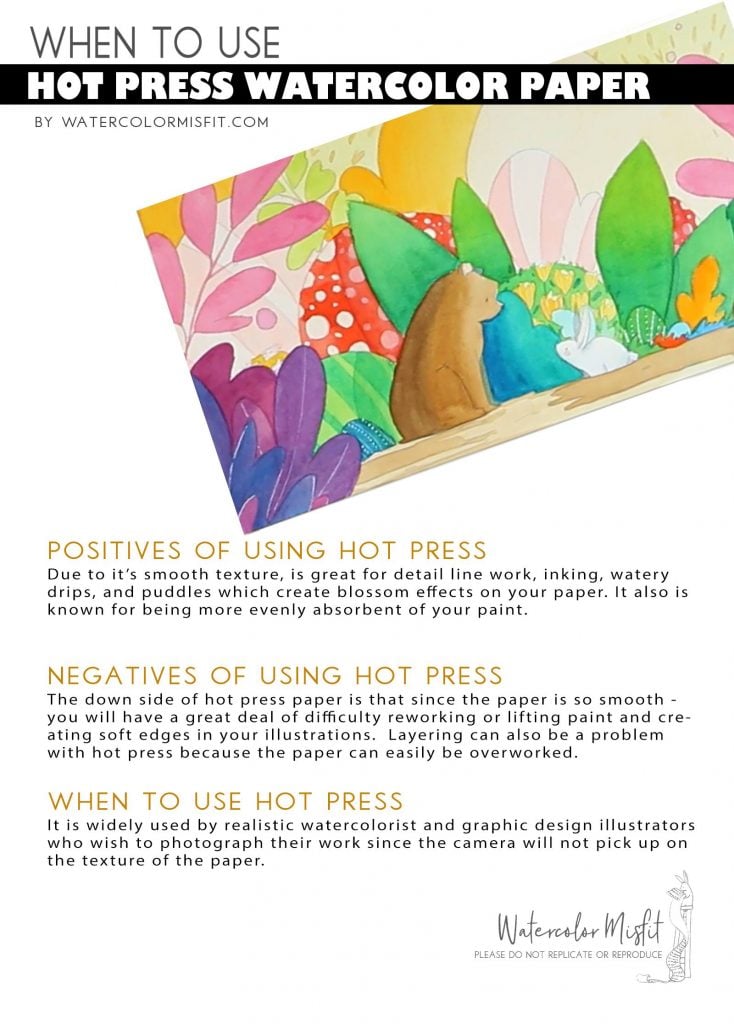
The good: Because it’s so smooth, hot press paper is great for detail work – especially line work, inking, and those watery drips and puddly blossom effects. It also absorbs paint more evenly. It’s a popular choice for realistic watercolorists and graphic design illustrators, since the smooth surface photographs and scans cleanly – the camera doesn’t have to fight the paper’s texture. If you want to digitize your work, hot press is a strong option. I also find the paint looks a bit more vibrant on hot press, simply because of how the texture photographs and films.
The bad: That same smoothness makes it hard to rework or lift paint once it’s down. Soft edges can be trickier to create. And because hot press paper is less durable than cold press, it’s easier to overwork – which can be a problem if you’re layering to build depth.
Cold Press Paper – The Good & Bad

The good: That bumpy texture acts more like a sponge, soaking up water quickly and drying a bit slower than hot press – which gives you more time to build smooth washes and effects. Cold press is also more durable, so it holds up well to layering and pouring techniques, and it’s easier to lift color when you have one of those “oopsie” moments.
The bad: The texture that makes cold press so forgiving also makes it harder to ink, especially with a pen, and trickier for tiny, intricate line work – it’s not impossible, just more work than on hot press. I also find cold press can look a little less vibrant when scanned, filmed, or photographed, since the camera seems to pick up more light off hot press paper. Plenty of artists still scan and photograph cold press work beautifully – it just takes more finessing.
Cold press is considered the most versatile and forgiving watercolor paper, which is why it’s also the most widely used – and the paper I’d recommend most for beginners.
So Which Paper Should You Use?
Honestly, I use both – it depends on the project. If I want to digitize a piece, I lean toward hot press. If I’m painting a final piece or experimenting with color, I lean toward cold press, mostly because I find it easier to work on overall.
One tip worth knowing: not all cold press paper is created equal. Some cold press papers have more tooth than others, which is part of why watercolor paper choice is such a personal preference – some artists love a heavier tooth, others prefer it smoother.